
Exterior Cleaning Company | Professional Powerwashing Maintenance|San Ramon
Using the wrong method is the single most expensive mistake in exterior cleaning, and it is almost always avoidable. Here is the honest explanation of both, from a licensed contractor who uses each of them every week.
Pressure washing uses force. High-pressure water does the cleaning, and it belongs on hard, durable surfaces that can take it. Soft washing uses chemistry. Low-pressure water carries a cleaning solution that kills and lifts the growth, and the surface is never blasted. Roughly speaking: concrete gets pressure, almost everything else gets soft washing.
The reason this matters is that the damage from choosing wrong is permanent and expensive. High pressure on a roof strips the protective granules off shingles and shortens the roof's life. High pressure on stucco etches the finish and drives water into the wall. High pressure on wood carves wand marks and raises the grain. None of that can be undone. Meanwhile, soft washing a driveway simply will not clean it, so the job fails the other way.
This page explains how each method works, which surfaces need which, and what a legitimate contractor should be telling you. If you only read one section, make it the surface table further down.
A pressure washer forces water through a narrow tip at high pressure, and the mechanical energy of that water dislodges whatever is on the surface. It is extremely effective at removing ground-in dirt, tire marks, oil film, and surface staining from materials that are hard enough to take it.
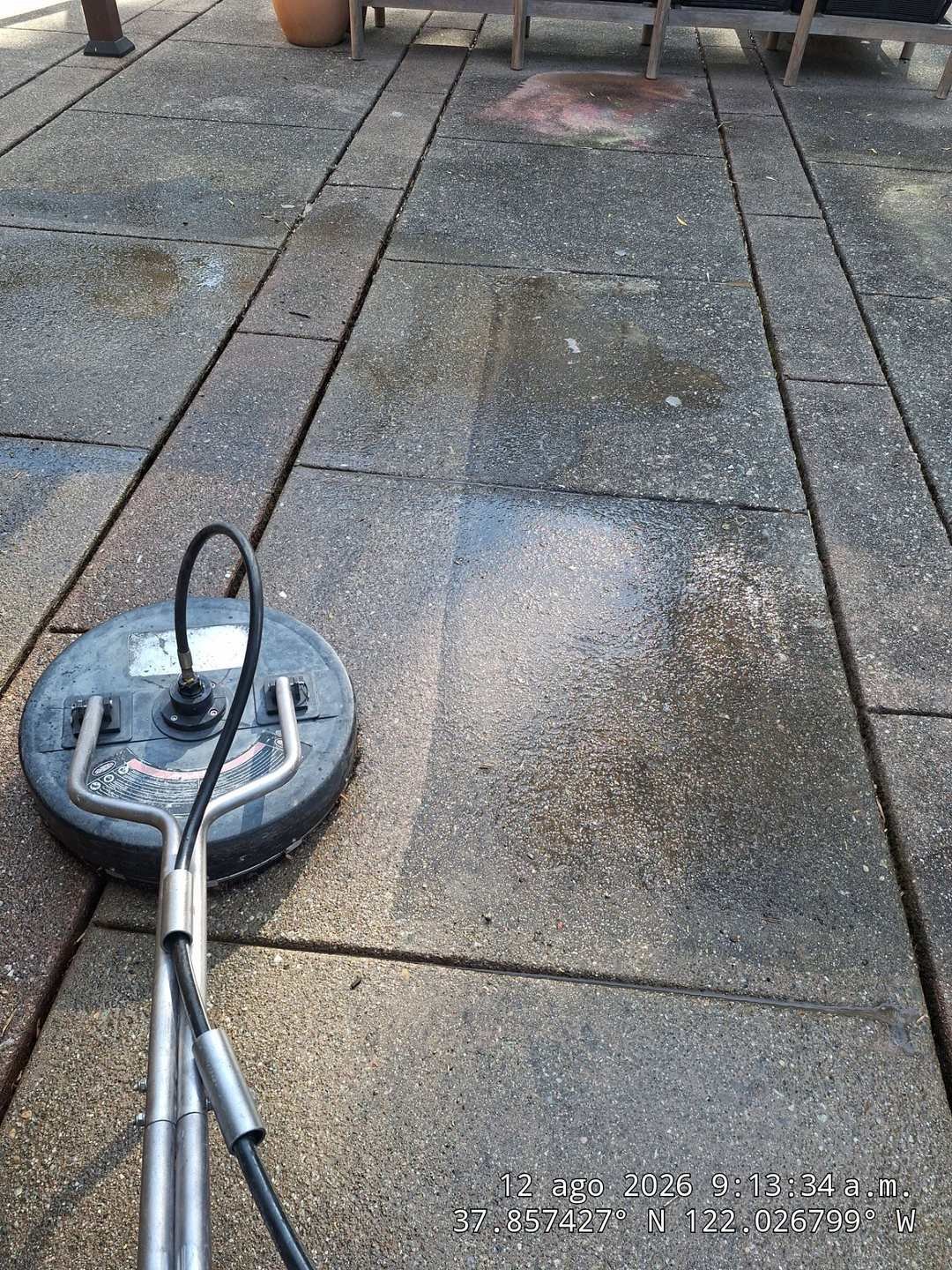
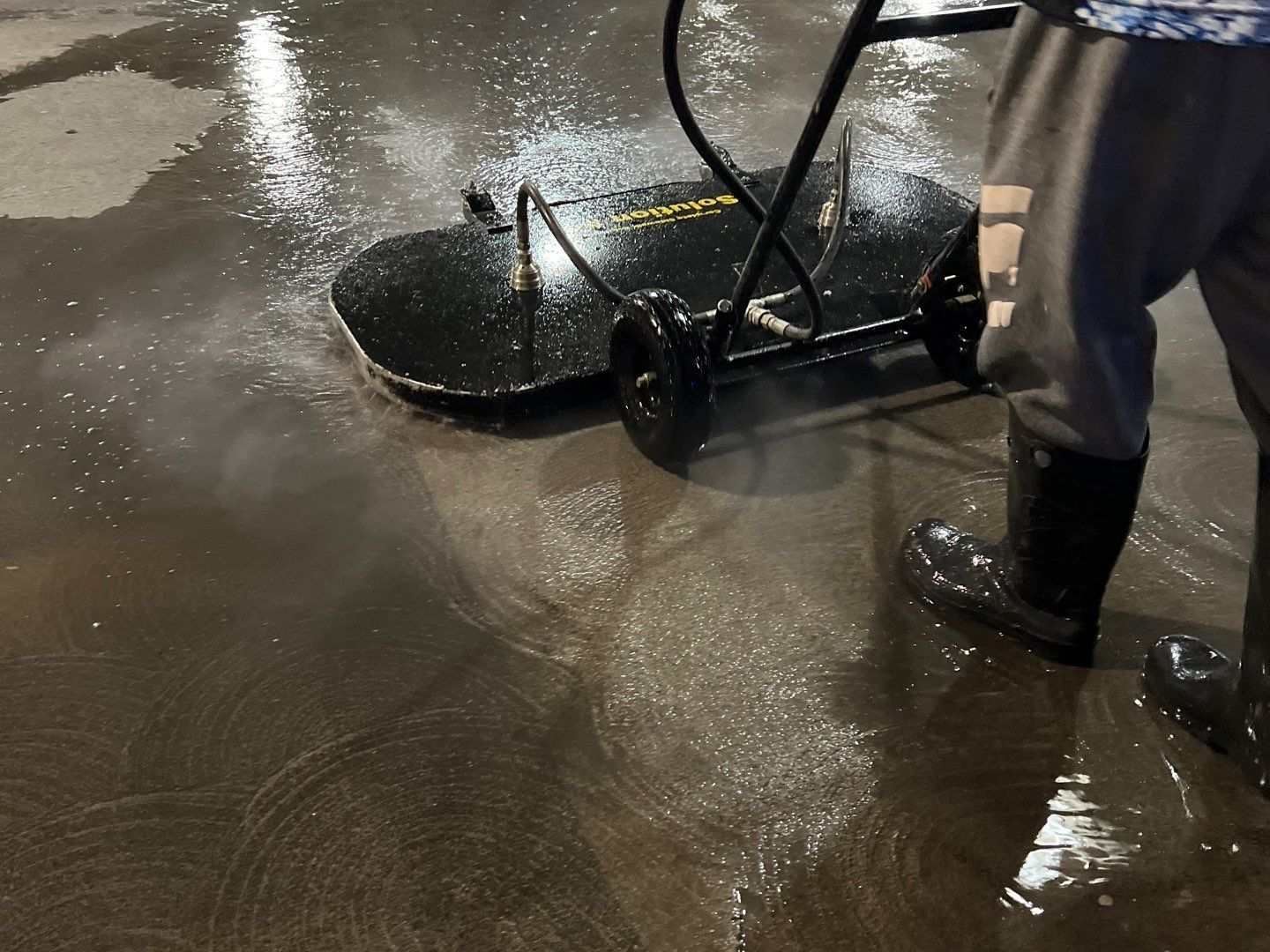
For large flat areas we generally use a surface cleaner rather than a wand. It is a rotating head inside a housing that keeps the spray at a constant height and distance, which is what gives you an even, stripe-free finish across a driveway instead of the zebra pattern a wand leaves in untrained hands.
Its real limitation: pressure removes what is on top. On a roof or a north-facing wall, the staining is biological and its roots sit in the surface. Pressure blasts off the visible growth and leaves the organism behind, so it returns quickly, and the surface has been damaged for nothing.
Soft washing applies a cleaning solution at low pressure, lets it dwell long enough to work, and then rinses gently. The solution does the cleaning. It kills algae, moss, lichen, and mildew at the root rather than merely knocking the visible layer off, which is why a soft-washed roof stays clean for years while a pressure-washed one greens up again within a season or two.
The pressure involved is comparable to a strong garden hose. The effectiveness comes from the chemistry, the dwell time, and the technician knowing the right dilution for the surface and the severity of the growth. That expertise is the whole job, and it is why soft washing done properly looks deceptively easy.
Why it lasts longer: because the organism is killed rather than displaced, regrowth starts from zero instead of from surviving roots. This is the single biggest practical difference for a homeowner.
If a contractor proposes the wrong column for your surface, that is a genuine warning sign.
| Surface | Correct method | Why |
|---|---|---|
| Asphalt shingle roof | Soft wash only | Pressure strips the protective granules, shortens roof life, and commonly voids the manufacturer warranty. |
| Tile, clay, or concrete tile roof | Soft wash only | Tile cracks and chips under pressure, and water forced under tiles ends up where it should never be. |
| Wood shake roof | Soft wash only | Pressure splits and erodes shake, and the damage is immediate and permanent. |
| Stucco | Soft wash | Pressure etches the finish and can drive water into the wall assembly behind it. |
| Vinyl, fiber cement, or wood siding | Soft wash | Pressure forces water behind the cladding, strips paint, and splits wood siding. |
| Painted trim and millwork | Soft wash | Any sound paint survives a soft wash. Pressure takes it off. |
| Wood fencing and decking | Low pressure plus solution | Wood is soft. High pressure leaves wand marks and raised grain that no stain will cover evenly. |
| Composite decking | Low pressure plus solution | Pressure mars the embossed grain and can damage the cap layer, voiding the warranty. |
| Gutters (exterior face) | Soft wash | The black vertical striping is oxidation and bonded residue, which needs chemistry, not force. |
| Concrete driveway, walkway, patio | Pressure wash | Hard and durable. This is where pressure genuinely belongs, ideally with a surface cleaner. |
| Pavers | Pressure, carefully | Effective, but too much pressure blasts out joint sand, so technique and re-sanding matter. |
| Brick and masonry | Depends on condition | Sound modern brick tolerates moderate pressure. Older or soft brick and deteriorating mortar need a gentle approach. |
| Solar panels | Low pressure, pure water | Panels are delicate and mineral-heavy water leaves spots. Never pressure wash a panel. |
Granule loss on a roof. After a pressure-washed roof, homeowners find granules in the gutters and at the base of downspouts. Those granules are the shingle's UV protection. Losing them does not show as a hole, it shows as a roof that ages years faster than it should, and it is the most expensive version of this mistake.
Striping and wand marks. On concrete, wood, and siding alike, an untrained operator working too close leaves a visible pattern of overlapping arcs. On concrete it is cosmetic but obvious in raking light. On wood it changes the surface texture permanently.
Water intrusion. This is the one owners do not see until later. Pressure directed upward under siding, into stucco, or beneath roof tiles puts water where the building's drainage never intended it. Staining appears on interior walls weeks later.
Growth that comes straight back. The most common complaint is not damage at all, it is a roof or wall that was pressure washed, looked great for a month, and greened up again by the following winter. The organism was never killed.
Our Mediterranean climate, wet winters followed by long dry summers, is remarkably good at growing biological matter on buildings. Months of winter damp let algae, moss, and lichen establish on roofs and shaded walls. Then months of dry heat and strong UV bake dust and oxidation into every exposed surface.
That combination means most of what makes an East Bay property look dirty is biological, not mechanical. It is growing, not merely deposited. And that is precisely the category of problem pressure cannot solve, because you cannot blast something into not being alive. It is the single best argument for understanding the distinction before hiring anyone here.
Add the mature tree canopy across Alamo, Danville, Moraga, Lafayette, and Orinda, the shaded north-facing slopes common in the hills, and irrigation overspray in nearly every yard, and you have conditions where the right method is not a preference, it is the difference between a result that lasts years and one that lasts weeks.
Get a Fast QuoteA competent contractor will answer surface by surface without hesitating, and will tell you that your roof is getting soft washed and your driveway is getting pressure. Vagueness here is the warning sign.
Soft washing uses real chemistry, and protecting plants is part of doing it properly. Pre-wetting, covering, and rinsing surrounding planting should be a normal part of their answer.
In California, exterior cleaning contractors should hold a CSLB license. You can verify any license number yourself on the CSLB website in under a minute. Ours is #1022456.
Soft washing is the method roofing manufacturers themselves recommend. Pressure washing a shingle roof can void coverage. If a contractor is casual about this question, that tells you what you need to know.
A properly soft-washed roof in the Bay Area typically stays clean for years, not months. If someone quotes you a cheap roof clean that needs repeating every season, they are pressure washing it.
Before-and-after photos should be standard, and they matter well beyond reassurance. Insurers increasingly want documented exterior maintenance, particularly on roofs and gutters.
The questions homeowners and property managers ask us most about method, damage, and how to hire well.
Every service below uses whichever method the surface genuinely needs, never a single approach applied to everything.
Low pressure and the correct treatment, the only method that belongs on a roof.
Stucco, siding, and trim cleaned without forcing water into the wall.
Where pressure genuinely belongs, done with a surface cleaner for an even finish.
Low pressure plus chemistry, because wood will not forgive the alternative.
Wood and composite cleaned safely, with the slip hazard removed.
Interior clearing plus soft washing the exterior face where the striping lives.
Tell us the surfaces and we will tell you honestly which method each one needs, including the ones that do not need cleaning at all.