
Fence cleaning and staining in the Bay Area
Fence Cleaning & Staining That Makes Old Redwood Look New Again
Gray, weathered, mildewed fencing is almost never worn out. It is usually just dirty. We clean, restore, and stain wood fences across San Ramon and the East Bay, protecting the wood instead of blasting it apart.
Diamond Certified500+ Five-Star ReviewsLicensed & Insured (CSLB #1022456)Open 24 Hours
Bay Area fence restoration
Your fence is probably not worn out, it is weathered
The single most common thing we hear from homeowners is that the fence "needs replacing." In the large majority of cases it does not. What looks like failure, that flat silver-gray surface, the black mildew streaks along the bottom boards, the green film on the shaded side, is surface weathering and biological growth sitting on wood that is structurally fine underneath.
Redwood and cedar, the two woods most Bay Area fences are built from, both contain natural oils that resist rot. What they cannot resist is UV. Sunlight breaks down lignin in the top layer of the wood and turns it gray, usually within a year or two of installation. That gray layer is microns thick. Clean it off correctly and the warm color underneath is still there.
A proper restoration is two jobs in sequence: clean the wood back to its real color, then seal or stain it so UV and moisture cannot immediately undo the work. Doing the first without the second is why some fences look great for one season and gray out again by the next.
Get a Fast Quote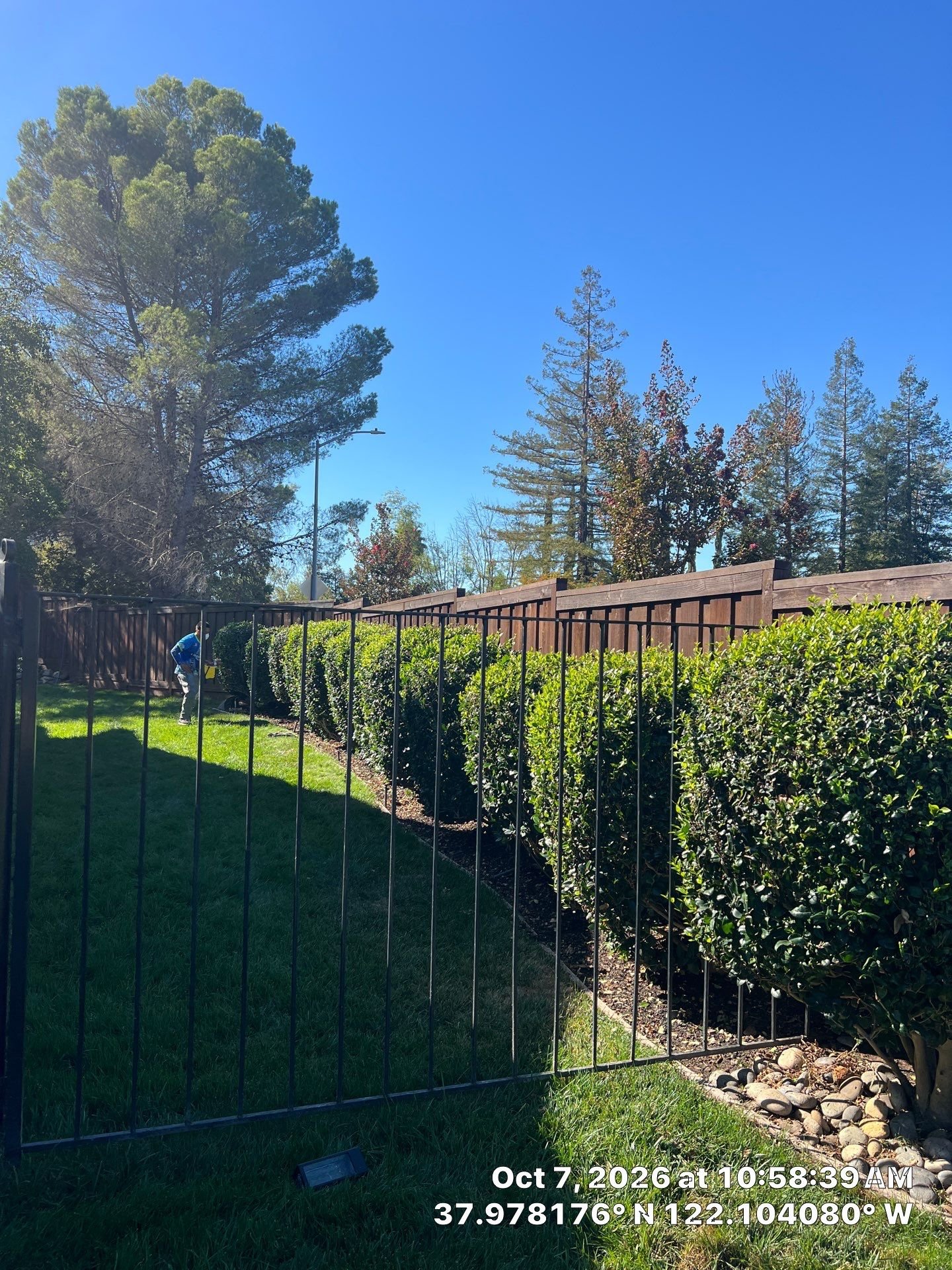
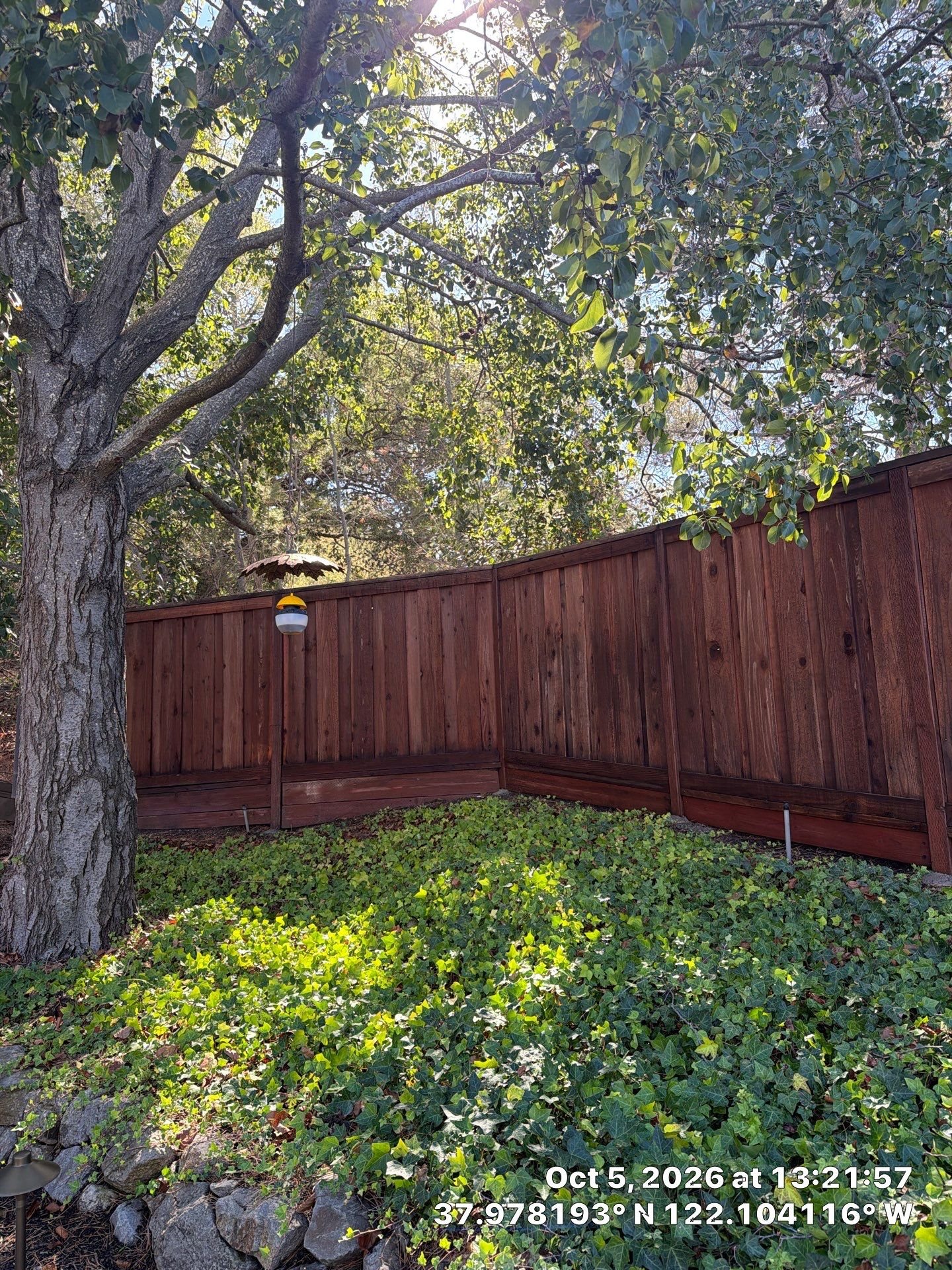
Method matters
Can you pressure wash a wood fence without ruining it?
Yes, but only at the right pressure, and most people get this wrong. Wood is soft. A pressure washer in untrained hands at full trigger will carve visible wand marks into fence boards, raise the grain into a permanent fuzz, erode the soft spring wood between the harder grain lines, and leave a striped, furry surface that no stain will ever sit on evenly. That damage is not reversible. You cannot sand a whole fence back.
What we actually do. We clean fences with a low-pressure wash and the right cleaning solution, letting the chemistry lift the mildew, algae, and gray oxidation rather than relying on force. Where more mechanical help is needed we step pressure up carefully and keep the fan tip moving at a consistent distance. The goal is an even, open surface that accepts stain uniformly, not a surface that has been stripped.
Why the cleaner matters as much as the pressure. Plain water does not remove mildew, it just wets it. The dark speckling along the lower boards of a Bay Area fence is biological, and it has to be killed, not rinsed. We also neutralize the wood afterward where the job calls for it, because stain and sealer behave badly on wood left chemically unbalanced, and that is a common cause of blotchy results on DIY jobs.
See the work
Watch a fence come back to life
The difference between a weathered fence and a restored one is not subtle, and it happens faster than most owners expect. This is a real Bay Area job, board by board.
What you are watching. The wash is doing two jobs at once: lifting the mildew and algae growing in the grain, and taking off the thin gray layer of UV-damaged wood sitting on top of it. The color underneath was there the whole time.
Notice the pressure. The wand is kept moving at a consistent distance rather than held in one place. That is what prevents the wand marks and raised grain that ruin a fence permanently and leave a surface no stain will sit on evenly.
Once the wood is clean and properly dry, it takes a penetrating stain evenly, which is what makes the result last years instead of one season.
Get a Fast Quote
Choosing a finish
Stain, sealer, or paint: which does your fence actually need?
This is the decision that determines how your fence looks for the next several years, and it is worth understanding before anyone quotes you.
Clear sealer
A clear water repellent keeps moisture out but contains little or no pigment, and pigment is what blocks UV. On a sunny Bay Area fence line a clear-only product will let the wood gray again relatively quickly. It has its place on newer wood where an owner genuinely wants the natural look, but it is the shortest-lived option and we will tell you that up front.
Semi-transparent stain
This is what we recommend for most redwood and cedar fences, and it is the sweet spot. It carries enough pigment to block UV and hold color for years, while still letting the grain and character of the wood show through. It penetrates rather than forming a film, which matters enormously for the next point.
Solid stain and paint
Solid stain and paint form a film on the surface. That film looks excellent on day one and hides wood that is genuinely mismatched or previously painted. The catch is that film finishes eventually peel, and once a fence has been painted or solid-stained you are committed: stripping it later is expensive and rarely perfect. Penetrating stain fades gracefully; film finishes fail dramatically.
Oil-based or water-based
Oil-based penetrating stains soak deeper into redwood and cedar and tend to wear more evenly, which is why they remain popular for fencing. Modern water-based products have closed much of the gap and clean up easier. We select based on the wood, its condition, its exposure, and whether anything has been applied before, because a product that fights the existing finish is a guaranteed callback.
The honest short answer: for a weathered redwood or cedar fence in the East Bay, a thorough clean followed by a quality semi-transparent penetrating stain gives the best balance of appearance, longevity, and future maintainability.
What the service includes
Our fence restoration, start to finish
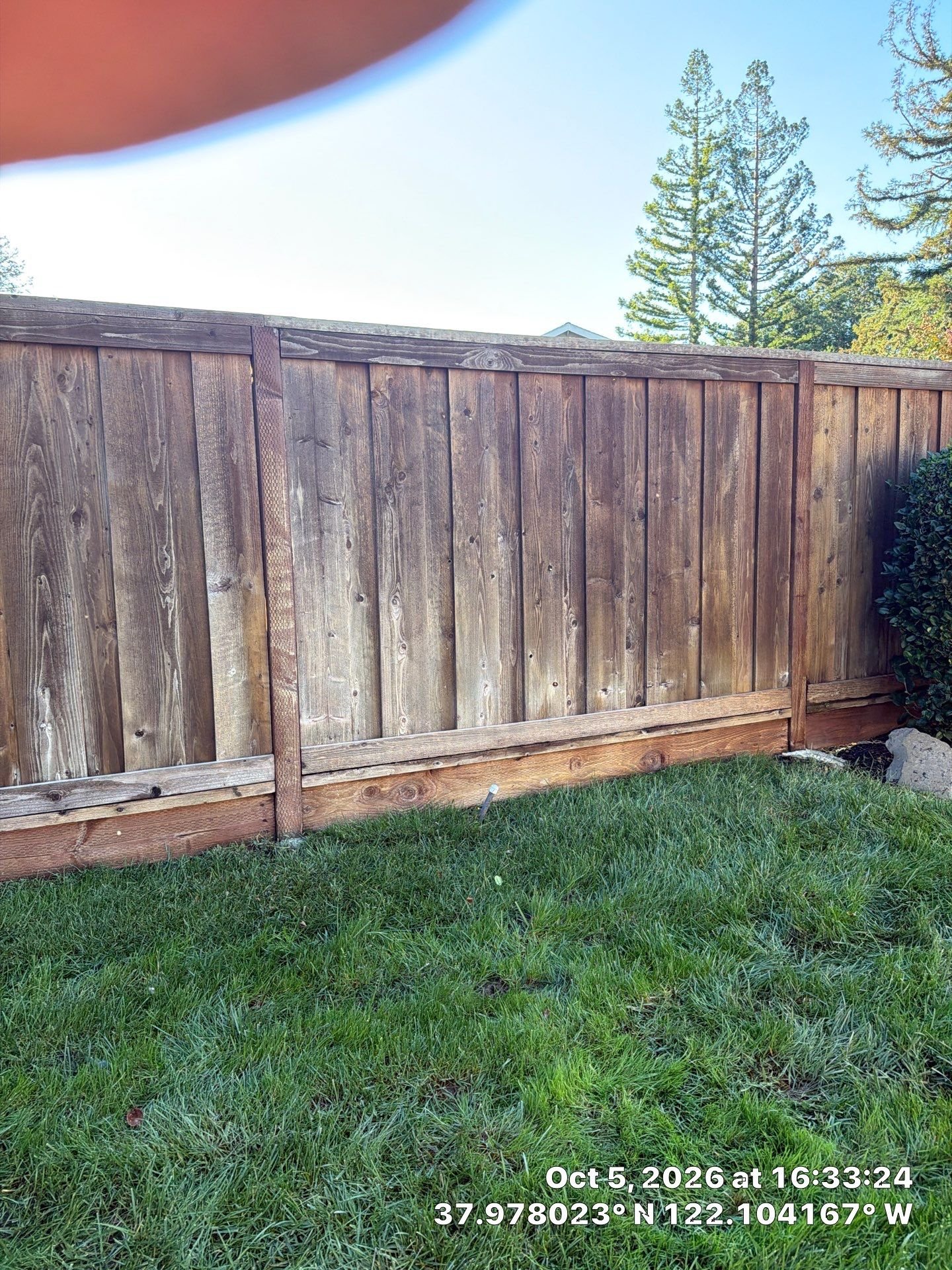
Stage one: the clean
- Inspection and honest assessment of the wood, the structure, and any previous finish before we quote.
- Landscape protection for planting, lawn, and hardscape along the fence line.
- Low-pressure wash with the correct cleaning solution to lift mildew, algae, and gray oxidation.
- Neutralizing and rinse where the job calls for it, so the surface is ready to accept finish evenly.
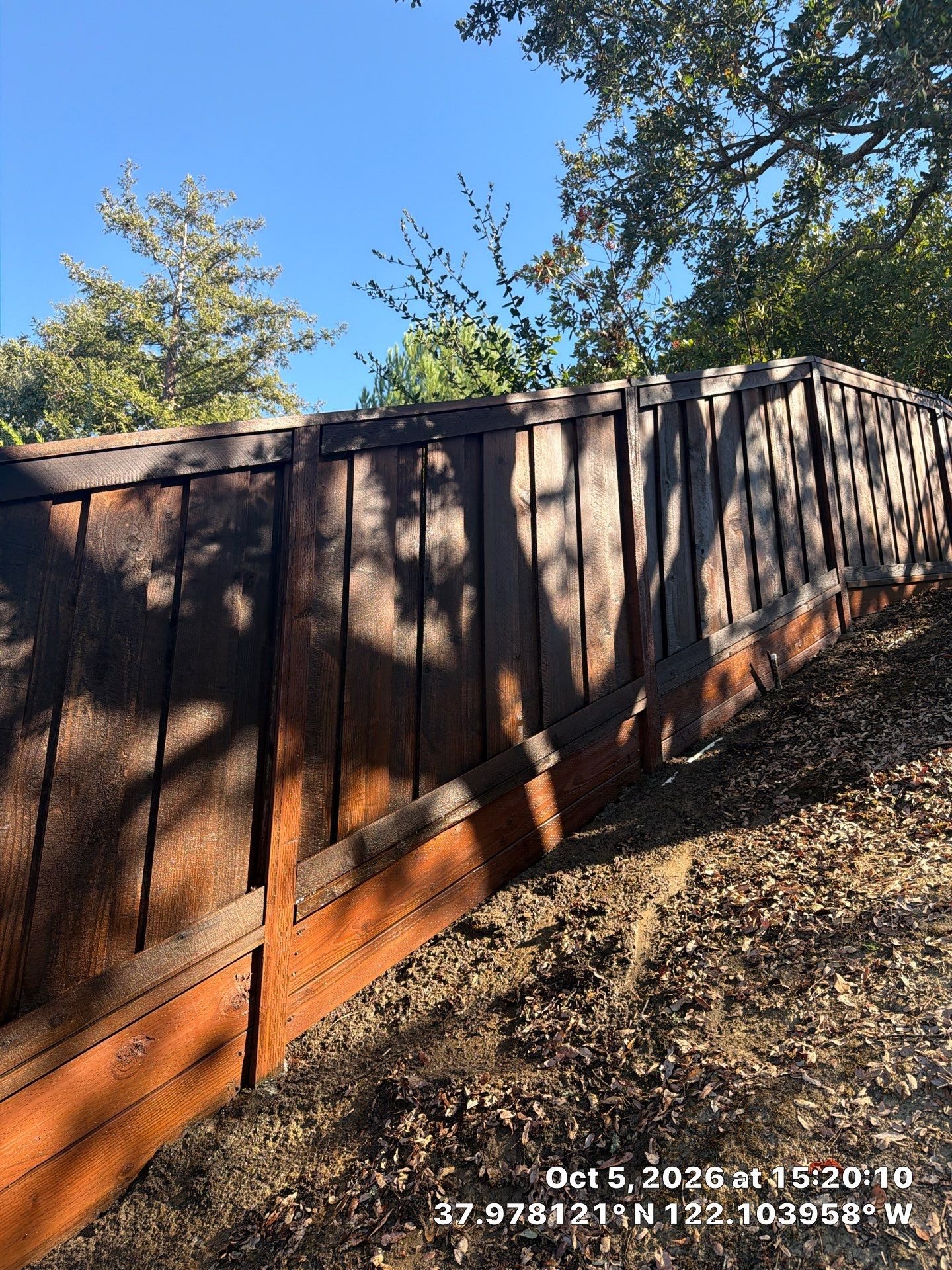
Stage two: the finish
- Proper dry time before any product is applied, planned into the schedule rather than skipped.
- Product selected for your wood and exposure, with the color confirmed with you first.
- Even application that works the finish into the grain rather than laying it on the surface.
- Clean, protected site at the end, with before-and-after documentation of the work.
Timing and schedule
When to stain, and how often it really needs doing
How long should you wait after cleaning before staining? The wood has to be dry, and that is not a formality. Stain applied to damp wood cannot penetrate, so it sits on the surface, dries unevenly, and fails early. Depending on the weather and the exposure of the fence, we typically allow a couple of days of dry conditions between the wash and the stain. Fences that back onto irrigated landscaping or sit in heavy shade need longer, and we plan for that rather than rushing the finish.
What is the best time of year in the Bay Area? Our long dry season is a genuine advantage here. Late spring through early fall gives reliable dry windows and moderate temperatures, which is exactly what stain wants. We avoid applying in the heat of a very hot afternoon, because stain that flashes off too fast does not penetrate properly, and we avoid the wet months when the wood never fully dries. If your fence needs doing in winter, we will be straight with you about waiting.
How often does a fence need re-staining? For most East Bay fences, a quality penetrating stain lasts roughly three to five years before it needs refreshing, though that range moves with exposure. The south and west faces that take direct afternoon sun fade first. Sections shaded by trees hold color longer but grow more mildew. Fence sections sitting in sprinkler overspray are almost always the first to fail anywhere on a property.
The good news about maintenance coats. Re-coating a fence that was properly stained before is far less work than the first restoration, because the wood is in good condition and only needs a light clean and a fresh coat. Owners who stay on a cycle spend less over the life of the fence than owners who let it go fully gray and need the full strip-and-restore treatment every time.
Get your free estimate
Built for East Bay conditions
What the Bay Area does to a wood fence
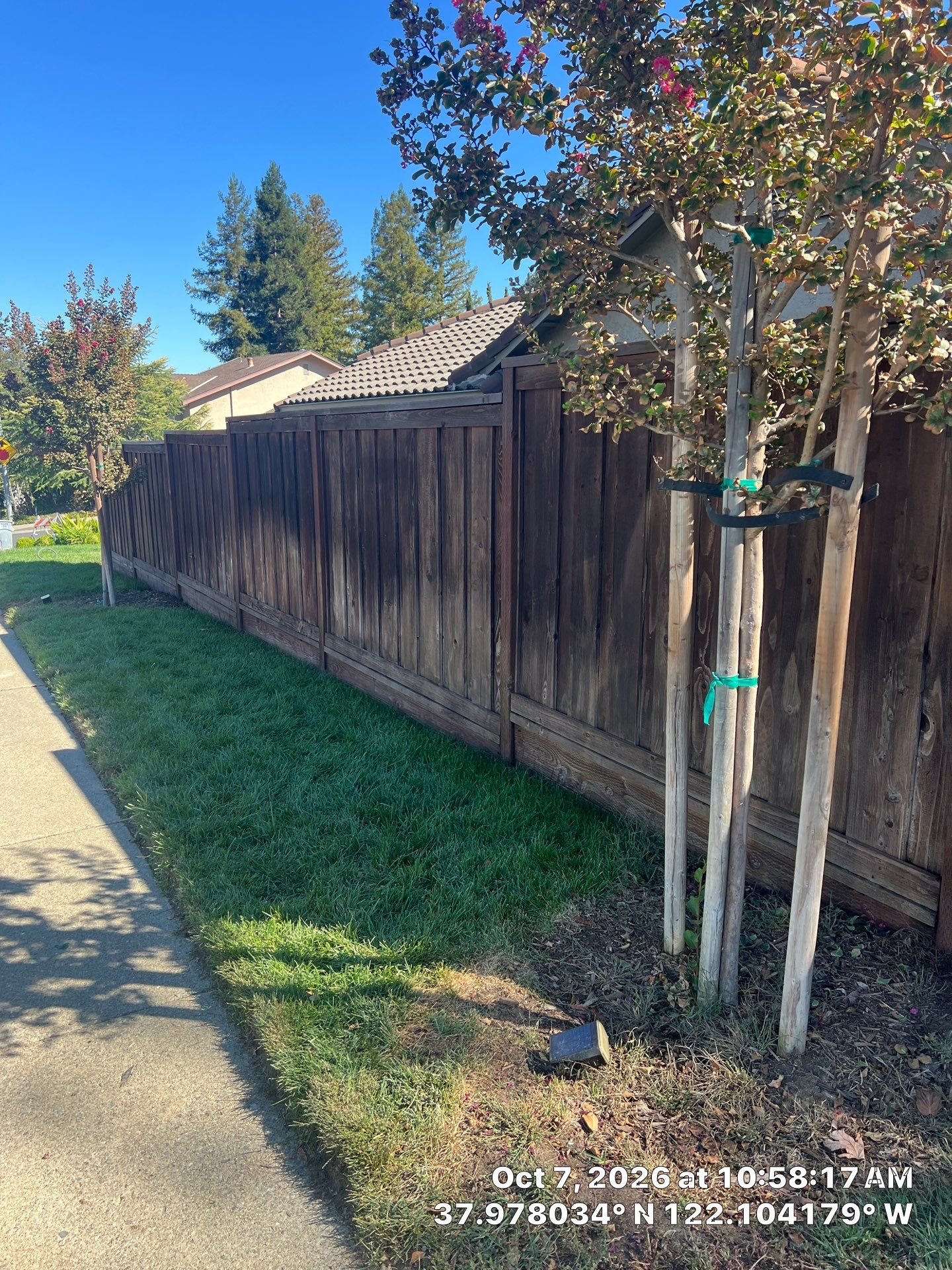
The wet winter, dry summer cycle. Our climate is unusually hard on fencing precisely because it swings. Months of winter damp let mildew and algae establish on the shaded faces and along the bottom boards closest to the soil. Then months of dry heat and strong UV bleach the exposed faces gray. A fence here is fighting biological growth half the year and sun damage the other half.
Sprinkler overspray. This is the quiet fence killer across East Bay yards, and almost nobody connects the two. Irrigation hitting the same boards several times a week keeps that section permanently damp, grows dark mildew, and in hard-water areas leaves mineral deposits in the grain. If one stretch of your fence looks far worse than the rest, walk out and watch your sprinklers run. We will point it out when we see it, because fixing the spray pattern protects the work.
Redwood, and why it matters here. So much Bay Area fencing is redwood, which weathers to that distinctive silver-gray and is often assumed to be dead when it is simply sun-bleached. Redwood also takes penetrating stain beautifully once properly cleaned, which is why restoration results on these fences tend to be dramatic.
Understanding the investment
What drives the cost of fence cleaning and staining?
There is no flat per-foot number that is honest without seeing the fence, because two fences of identical length can be very different jobs. Here is what actually moves the price, so you can budget sensibly and compare quotes on equal terms.
| Factor | Why it changes the price |
|---|---|
| Linear feet and height | The base measure of the job. A six-foot fence has meaningfully more surface area than a four-foot fence of the same run. |
| One side or both | Many fences are shared with a neighbor. Finishing both faces is close to double the surface area, and access to the far side is not always straightforward. |
| Condition of the wood | A lightly grayed fence cleans quickly. One with heavy mildew, years of oxidation, or old failing finish takes significantly more prep, which is where most of the labor lives. |
| Previous coatings | Bare or previously oil-stained wood is straightforward. A fence that was painted or solid-stained and is now peeling needs far more work and limits what can be applied over it. |
| Product selected | Clear sealer, semi-transparent, and solid stain differ in material cost and in how many coats the wood will take. |
| Access and landscaping | Tight side yards, slopes, mature planting against the fence, and anything needing masking or protection all add time. |
We give a clear, itemized written quote after seeing the fence, with no vague ranges and nothing added afterward. If a fence genuinely is past saving, with rotted posts or failed structure, we will tell you honestly that staining it is money poorly spent rather than selling you a finish on a fence that needs rebuilding.
Simple from start to finish
Getting started takes three steps
1
Request your free estimate
Tell us about the fence, its length, and its condition. We provide a clear, no-obligation written quote with upfront pricing.
2
We clean, then we finish
Trained, insured technicians clean the wood properly, allow correct dry time, and apply the finish we agreed on.
3
Enjoy the result
Your fence comes back to its real color and is protected against sun and moisture, with the work documented.
More exterior services
Often booked together
Most owners restoring a fence are getting the rest of the yard handled at the same time. These are the services we are most often asked to combine with it.
Deck cleaning & staining
Same wood, harder conditions. Decks hold water and need a different schedule than fencing.
House soft washing
Siding, stucco, and trim cleaned at low pressure, the same gentle method we use on wood.
Paver patio cleaning & sealing
Restore and protect the hardscape your fence line frames.
Commonly asked questions
Fence cleaning and staining, answered
The questions East Bay homeowners ask us most about restoring and protecting a wood fence.
Can you pressure wash a wood fence without damaging it?
Yes, at the right pressure and with the right cleaning solution. High pressure in untrained hands carves wand marks into soft wood, raises the grain permanently, and leaves a striped surface that stain will never sit on evenly. We clean at low pressure and let the chemistry do the work, stepping up carefully only where needed.
Should I stain or seal my fence?
For most weathered redwood and cedar fences in the East Bay we recommend a semi-transparent penetrating stain. It carries enough pigment to block UV and hold color for years while still showing the grain. Clear sealers repel water but contain little pigment, so the wood grays again relatively quickly in our strong sun.
Is it better to stain or paint a fence?
Stain penetrates the wood and fades gracefully. Paint and solid stain form a film that looks excellent initially but eventually peels, and once a fence is painted you are committed, because stripping it later is expensive and rarely perfect. For bare redwood or cedar, penetrating stain is usually the better long-term decision.
How long should I wait after cleaning before staining?
The wood has to be properly dry, typically a couple of days of dry conditions depending on weather and exposure. Stain applied to damp wood cannot penetrate, so it sits on the surface and fails early. Fences in heavy shade or near irrigation need longer, and we build that into the schedule.
How often does a fence need to be re-stained?
For most East Bay fences a quality penetrating stain lasts roughly three to five years before needing a refresh. South and west faces that take afternoon sun fade first, shaded sections hold color longer but grow more mildew, and anything sitting in sprinkler overspray fails soonest.
When is the best time of year to stain a fence in the Bay Area?
Late spring through early fall, when our long dry season provides reliable dry windows and moderate temperatures. We avoid applying in extreme afternoon heat, because stain that dries too fast does not penetrate properly, and we avoid the wet months when the wood never fully dries out.
My fence is gray. Does that mean it needs replacing?
Usually not. That silver-gray is UV breaking down a microscopically thin top layer of the wood, not structural failure. Redwood and cedar both gray within a year or two of installation while remaining perfectly sound underneath. Cleaning removes that layer and the warm color returns. We will tell you honestly if posts or structure genuinely have failed.
How much does fence cleaning and staining cost?
It depends on linear feet and height, whether one side or both are being finished, the condition of the wood, any previous coatings, the product selected, and access along the fence line. We provide a clear, itemized written quote after seeing the fence, with nothing added afterward.
Do you stain both sides of the fence?
We can, and many owners do want both faces finished. Because a shared fence is often partly on a neighbor's side, we discuss access and coordination before the job rather than assuming. Finishing both faces is close to double the surface area, so it is quoted accordingly.
Why does one section of my fence look much worse than the rest?
Nine times out of ten it is sprinkler overspray. Irrigation hitting the same boards several times a week keeps that stretch permanently damp, grows dark mildew, and in hard-water areas leaves mineral deposits in the grain. Adjusting the spray pattern protects the restoration work.
Do you clean vinyl and composite fencing too?
Yes. Vinyl, composite, and metal fencing all clean up well with the appropriate low-pressure approach and solution, and none of them need staining. The method differs from wood, but the principle is the same: the right chemistry at safe pressure rather than brute force.
Are you licensed and insured?
Yes. Professional Powerwashing and Maintenance is CSLB licensed (#1022456), fully insured, and Diamond Certified. Certificates of insurance are available on request, and every job is documented with before-and-after photos.
Bring your fence back
Stop looking at a gray fence
Most weathered fences in the East Bay are not worn out, they are dirty and unprotected. Let us show you what is underneath before you spend money replacing it.