

I’m Brandon Cody, owner of Professional Powerwashing and Maintenance and a dedicated entrepreneur focused on delivering top-quality service and building long-lasting relationships. With years of experience in creating efficient systems, my team and I specialize in helping businesses maintain clean, professional properties that reflect their commitment to excellence.
I’m always interested in connecting with like-minded professionals and businesses looking for reliable, high-standard service. Let’s connect!
Calcium Deposit Removal in Walnut Creek, CA: How We Remove Hard Water Buildup From Exterior Walls
That chalky, almost crusty white residue creeping across an exterior wall isn’t ordinary dirt, and it won’t come off with a garden hose and a stiff brush. It’s a calcium deposit, and once it’s had enough time to set, removing it properly takes a very different approach than a standard exterior cleaning. This guide walks through what these deposits actually are, why they form where they do, what it takes to remove them safely, and how to keep them from coming back — using a recent job at a retirement community here in Walnut Creek as a real-world example.
What Calcium Deposits Actually Are
Calcium deposits form when water carrying dissolved minerals — primarily calcium carbonate — evaporates off a surface and leaves that mineral content behind. This is the same basic process that causes limescale inside a kettle or hard water spots on a shower door, just playing out on a much larger, more exposed scale outdoors. Every time water touches a wall, a section of concrete, or a piece of stone and then dries, it leaves a microscopic trace of mineral residue. On its own, one evaporation cycle is nothing. Repeated across months or years, in a spot that gets wet on a regular basis, those traces build into a visible, hardened layer.
The Bay Area’s water supply carries enough mineral content that this process shows up reliably on properties throughout Walnut Creek, Danville, Alamo, Blackhawk, San Ramon, Dublin, Pleasanton, and Lafayette, particularly on exteriors near irrigation systems, fountains, or anywhere water routinely collects and dries in the same location.
Calcium Deposits vs. Efflorescence: They’re Not the Same Thing
It’s worth pausing here, because these two are easy to confuse and often get lumped together, even though they call for different treatment.
Efflorescence is the powdery, almost dusty white substance that appears when water moves through masonry or mortar joints, carrying salts to the surface as it evaporates. It tends to look chalky and can often be brushed away fairly easily, though it may return if the underlying moisture source isn’t addressed.
Calcium deposits, by contrast, tend to be thicker and crustier, with a texture closer to scale than powder. They form from mineral-heavy water evaporating directly on a surface rather than migrating up through it, and they bond more stubbornly as a result. A quick way to tell them apart: wet the area and watch what happens. Efflorescence often becomes less visible when damp and reappears as the surface dries, while a true calcium deposit tends to stay put regardless of moisture, because the mineral has already bonded to the surface itself.
Getting this distinction right matters, because a treatment suited to light efflorescence often isn’t strong enough to touch a hardened calcium deposit, and a treatment aggressive enough for heavy calcium buildup can be more than a delicate surface needs.
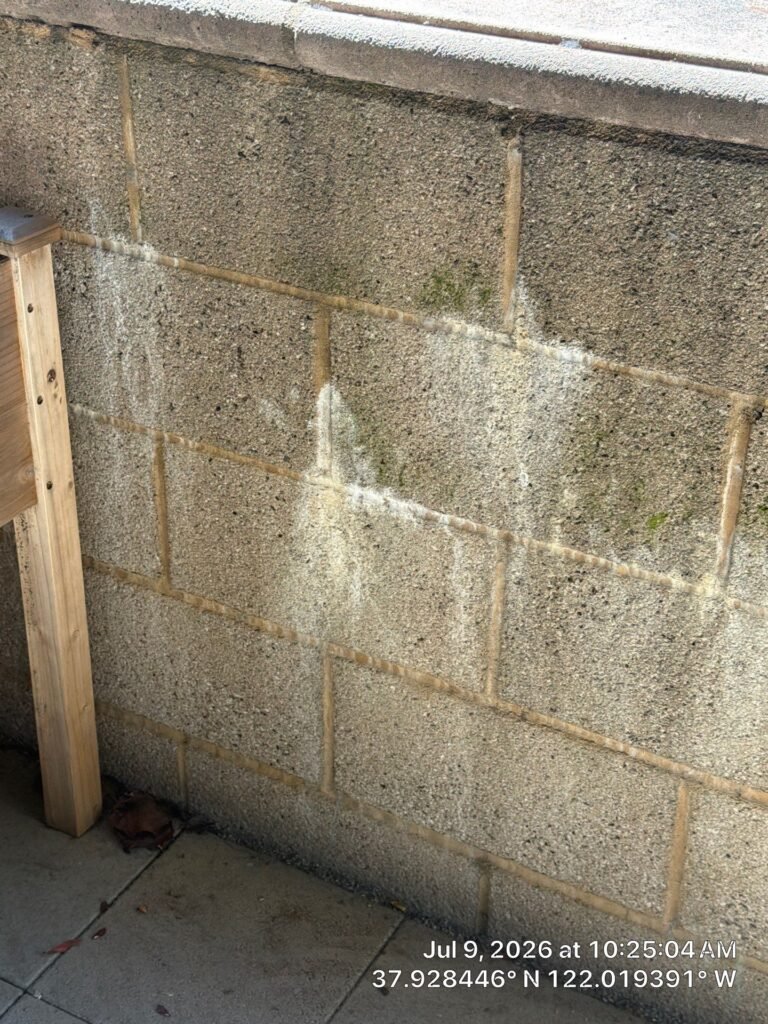
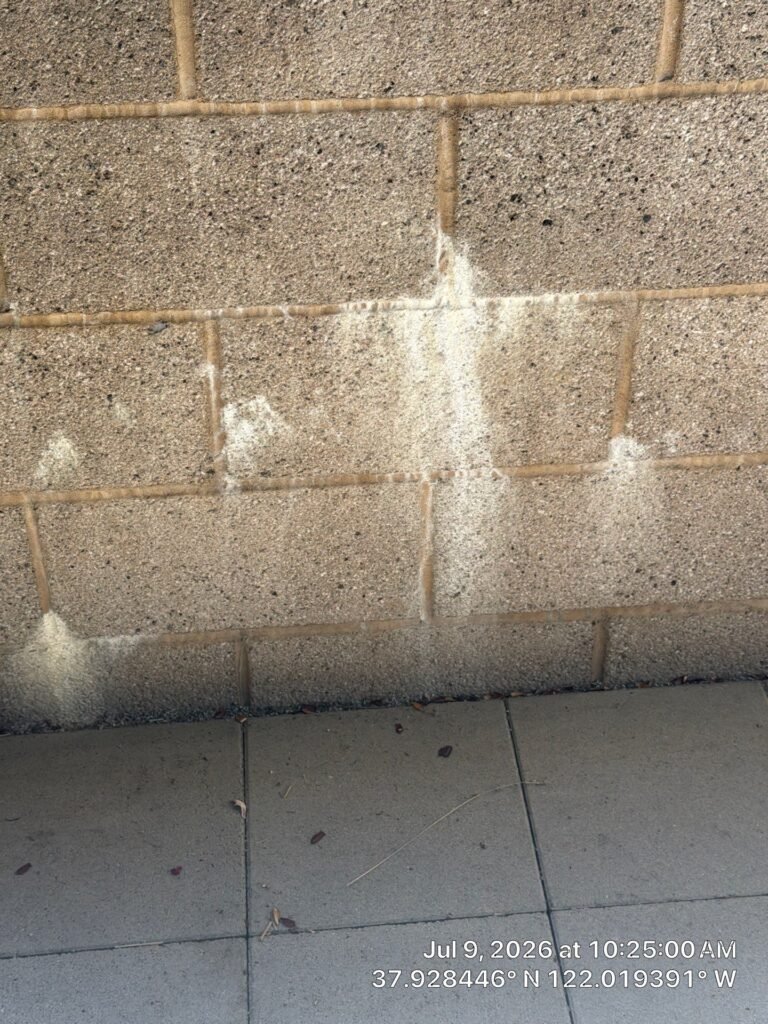
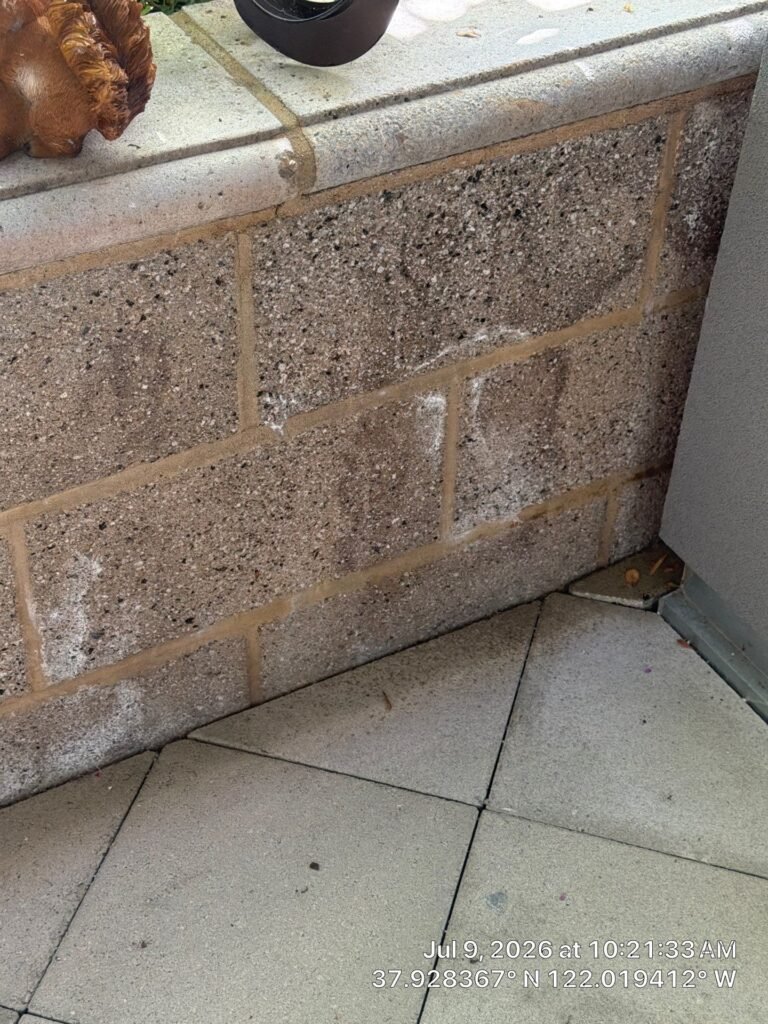
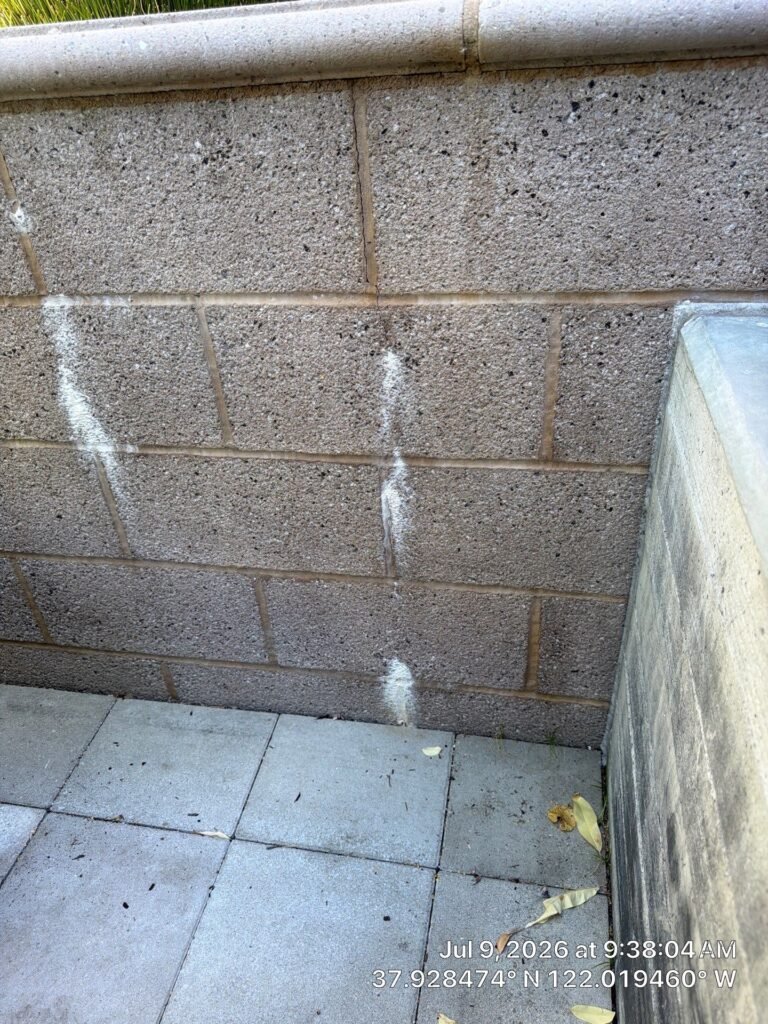
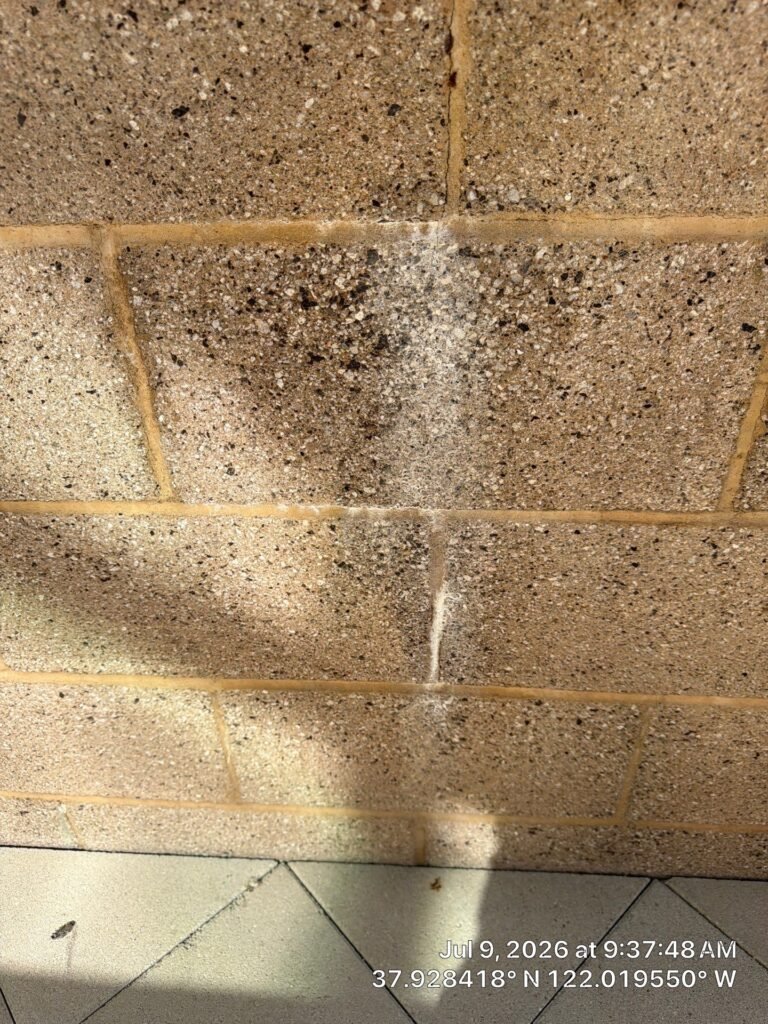
Where Calcium Buildup Tends to Show Up
Certain areas of a property are far more prone to this kind of staining than others, and recognizing the pattern helps explain why some walls end up coated while a wall twenty feet away stays clean.
Irrigation overspray is one of the most common culprits, particularly where a sprinkler head sits close to a wall or fence line and mists the same section day after day. Courtyards and shared outdoor spaces at properties like the retirement community we worked on in Walnut Creek often have exactly this setup, with irrigation running on a fixed schedule near walkways and low walls. Gutters and downspouts that overflow or drip in a consistent spot create a similar pattern, as do areas near pools or water features where splash-out repeatedly wets the same section of hardscape. Even rainwater, if the local water table carries enough dissolved mineral content, can contribute to buildup over enough seasons, particularly in areas where runoff pools before draining.
Once you know to look for it, the buildup tends to trace a clear line back to a water source — which is also useful information when it comes to preventing it from returning after cleaning.
Why DIY Methods Often Fall Short on Exterior Surfaces
A search for calcium removal turns up plenty of household advice: vinegar, baking soda paste, lemon juice, commercial descalers built for faucets and showerheads. These approaches genuinely work well on small, controlled indoor surfaces like a chrome fixture or a glass shower door, where the calcium layer is thin and the material underneath is uniform and non-porous.
Exterior walls are a different problem entirely. Stucco, painted siding, natural stone, and masonry are porous to varying degrees, which means a household acid like vinegar can behave unpredictably — sometimes barely touching a heavy deposit, other times etching or discoloring a sensitive surface faster than it lifts the buildup. Scale that up from a showerhead to an entire courtyard wall, and the margin for error gets a lot less forgiving. A DIY approach that leaves streaking, uneven lightening, or surface etching on a small bathroom fixture is an easy fix. The same mistake across a large exterior surface, especially one with architectural finish or natural stone, can turn into a far more expensive repair than the original staining ever was.
This is really the dividing line between a job that’s fine to tackle with a spray bottle and one that calls for a professional: surface area, material sensitivity, and how long the deposit has had to harden.
How We Approach Calcium Deposit Removal
The process starts with an assessment of the surface itself, since stucco, stone, metal, and concrete all respond differently to cleaning agents and need to be treated accordingly. From there, we apply detergents formulated specifically to break down calcium bonds rather than a generic all-purpose cleaner, and we give that solution enough dwell time to actually soften the mineral layer before any scrubbing begins. Rushing this step is one of the most common reasons a DIY attempt looks half-finished — the chemistry needs time to work before physical agitation does much good.
Once the solution has had time to break the bond, targeted scrubbing lifts what remains, followed by a full rinse to clear both the loosened residue and any cleaning agent left on the surface. On the recent job that prompted this post, our crew worked through exactly this sequence on a courtyard wall at a retirement community here in Walnut Creek, alongside window cleaning, additional courtyard cleaning, and garage cleaning handled during the same visit. The wall went from a heavily crusted, uneven white surface to a clean, restored finish, and the difference is the kind of before-and-after that’s hard to overstate in words alone.
Not All Surfaces Should Be Treated the Same Way
Because calcium deposits show up on so many different materials, the right treatment really depends on what’s underneath the buildup.
Stucco and painted surfaces need a gentler approach, since overly aggressive scrubbing or acidic solutions can strip paint or roughen a textured finish. Natural stone, particularly softer stones like limestone or travertine, is sensitive to strong acids in a different way — the wrong product can etch the stone’s surface permanently, which is a far worse outcome than the original staining. Concrete and masonry tend to tolerate a stronger approach and often benefit from it, given how porous and absorbent those materials typically are. Metal surfaces, including railings and fixtures, call for their own set of considerations to avoid corrosion once the mineral layer is removed.
Matching the right detergent and technique to the right substrate is really the difference between a cleaning job that restores a surface and one that damages it in the process of trying to clean it.
Keeping Calcium Deposits From Coming Back
Once a surface has been properly restored, the more useful question is how to keep it that way. A few things make an outsized difference. Adjusting irrigation heads so they aren’t spraying directly onto walls or hardscape removes the most common cause of localized buildup. Keeping gutters and downspouts clear prevents the kind of repeated dripping that slowly recreates the same staining pattern. And on porous surfaces like concrete or certain stone, a protective sealant can meaningfully slow how quickly new mineral deposits are able to bond.
The most effective approach, though, is simply not letting buildup get the months or years of head start that makes it so stubborn in the first place. That’s the entire premise behind our preventative maintenance membership plans for commercial as well as residential properties – that keeps a property’s exterior surfaces on a regular cleaning cycle, so mineral deposits, algae, and general grime never get the opportunity to harden into the kind of job that requires specialized detergents and hours of scrubbing to undo.
Frequently Asked Questions
Left alone long enough, yes. Beyond the appearance, mineral deposits can contribute to surface degradation on more porous materials over time, and the water source causing the buildup — often a leak, overflow, or misdirected irrigation — can create its own separate problems if it goes unaddressed.
Water pressure alone typically isn’t enough for a hardened calcium deposit; it needs to be paired with the right detergent and adequate dwell time first. Pressure washing without the correct chemical treatment beforehand risks driving water into a porous surface without actually lifting the mineral bond, and incorrect pressure or nozzle choice can damage sensitive materials like stucco or soft stone.
It depends heavily on proximity to irrigation, gutters, and other water sources, but many properties benefit from a professional check every six to twelve months, which is the kind of schedule our HomeGuard Maintenance Membership is built around.
Yes. We work throughout Walnut Creek, San Ramon, Danville, Alamo, Blackhawk, Dublin, Pleasanton, Lafayette, and the surrounding communities.
Get Your Property Assessed
If you’re noticing a chalky, crusted buildup on an exterior wall, courtyard, or hardscape anywhere in Walnut Creek or the surrounding area, it’s worth having it looked at before it spreads further or bonds any harder. Reach out and we’ll take a look.
Our ongoing maintenance plans are not just available for commercial property owners but also for homeowners. Ask us about HomeGuard Maintenance Membership if you’re a homeowner and you’d rather keep buildup like this from becoming a recurring problem in the first place.
EXCELLENT Based on 126 reviews
 Posted on Google
 Greg BouchakianThey did a great job! Very thorough, on time, and made sure I was happy when done.Posted on Google
 Mary ShefferThis company was a pleasure to work with. They were punctual, courteous and did a terrific job. This was sll the way at the top with Josh to the men who actually did the work. My house is 40 years old and it now looks almost brand new. 😊 Thank you so much!Posted on Google
 tom albertexcellent service for a very moldy patio area as well as walkways. I would recommend these folks without reservation.Posted on Google
 DAVID ROSEAnd work was done in a fast and efficient mannerPosted on Google
 Kunjal VaitharaI couldn’t be happier with the service from Professional Power Wash and Management (PPWPM)! This job was done at my home in Walnut Creek, and the team did an absolutely fantastic job with both the power washing and the windows—everything looks spotless and refreshed. The windows are super clean I have a property with a front yard, backyard, and side yard—quite an area to be cleaned—along with a mix of surfaces including bricks, concrete, and even a tennis court. They handled every single detail with care and precision. It’s not easy to manage such variety, but they truly did an outstanding job across the board. A special shoutout to Ray, who I was in touch with throughout the process. He is truly wonderful—extremely patient, professional, and has outstanding customer service. What I really appreciated is that he genuinely understands what a customer wants. I’m someone who is very particular (a bit of a clean freak!), and when I pointed out certain things, he made sure everything was taken care of without hesitation. That level of attention and responsiveness really stands out. Honestly, when a business truly takes care of its customers, you know they’re going to do well—and that’s exactly the feeling I got here. Communication was seamless—every text message was responded to promptly, with no delays or confusion. The team was very punctual and arrived right on time. Everything was smooth and efficient from start to finish. They also offer a wide range of services, and based on this experience, I’ll definitely be using them again in the future. It was such a pleasant experience overall. You come across very few companies whose service is truly 10 on 10—and this is definitely one of them. I highly recommend PPWPM to everyone in Walnut Creek and beyond who is looking for power washing or any of the services they offer. I’m 101% sure they’ll do a great job. If you love a fresh-looking home, you will be absolutely happy and thrilled!Posted on Google
 Eva DeagenOn time. Friendly people. Great job. Great price.Verified by TrustindexTrustindex verified badge is the Universal Symbol of Trust. Only the greatest companies can get the verified badge who has a review score above 4.5, based on customer reviews over the past 12 months. Read more